Is a Dark Room Retreat Safe?
By Arigalan
A dark room retreat can offer rest, silence, and meaningful introspection. It can also be unfamiliar, emotionally demanding, and psychologically intense.
A responsible answer to the question “Is it safe?” is therefore not a simple yes or no.
Safety depends on the participant, the retreat duration, current physical and psychological health, preparation, freedom to leave, and the support available.
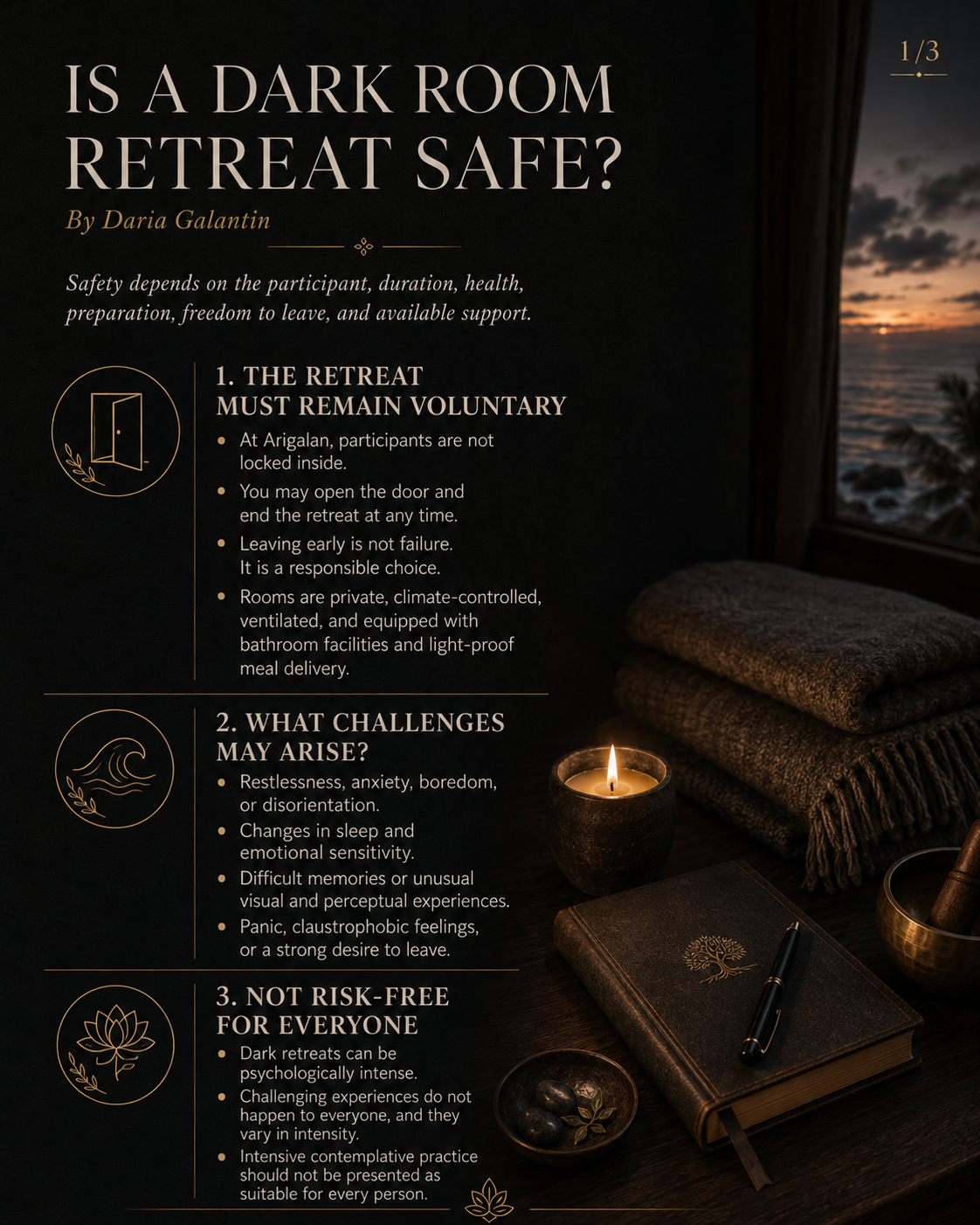
The Retreat Must Remain Voluntary
At Arigalan, participants are not locked inside the room. You may open the door and end the retreat at any time.
This freedom is fundamental.
Remaining longer is not a sign of greater spiritual achievement, and leaving early is not failure. A participant who recognizes their limit and responds appropriately is acting responsibly.
The rooms are private, climate-controlled, and equipped with sleeping space, bathroom facilities, ventilation, and light-proof meal delivery. Practical support is available when needed.
What Challenges May Arise?
Possible experiences include:
Restlessness
Anxiety
Boredom
Disorientation
Changes in sleep
Emotional sensitivity
Difficult memories
Unusual visual or perceptual experiences
Panic or claustrophobic feelings
A strong desire to leave
These responses do not occur for everyone, and they vary in intensity.
A recent peer-reviewed qualitative study of prolonged dark therapy reported both unusual perceptual phenomena and psychologically challenging experiences. Research on meditation has also found that intensive contemplative practice can sometimes be associated with unpleasant or adverse effects.
This does not mean that meditation or dark retreats are inherently dangerous. It means they should not be sold as risk-free experiences suitable for every person.
Arigalan’s Contraindications
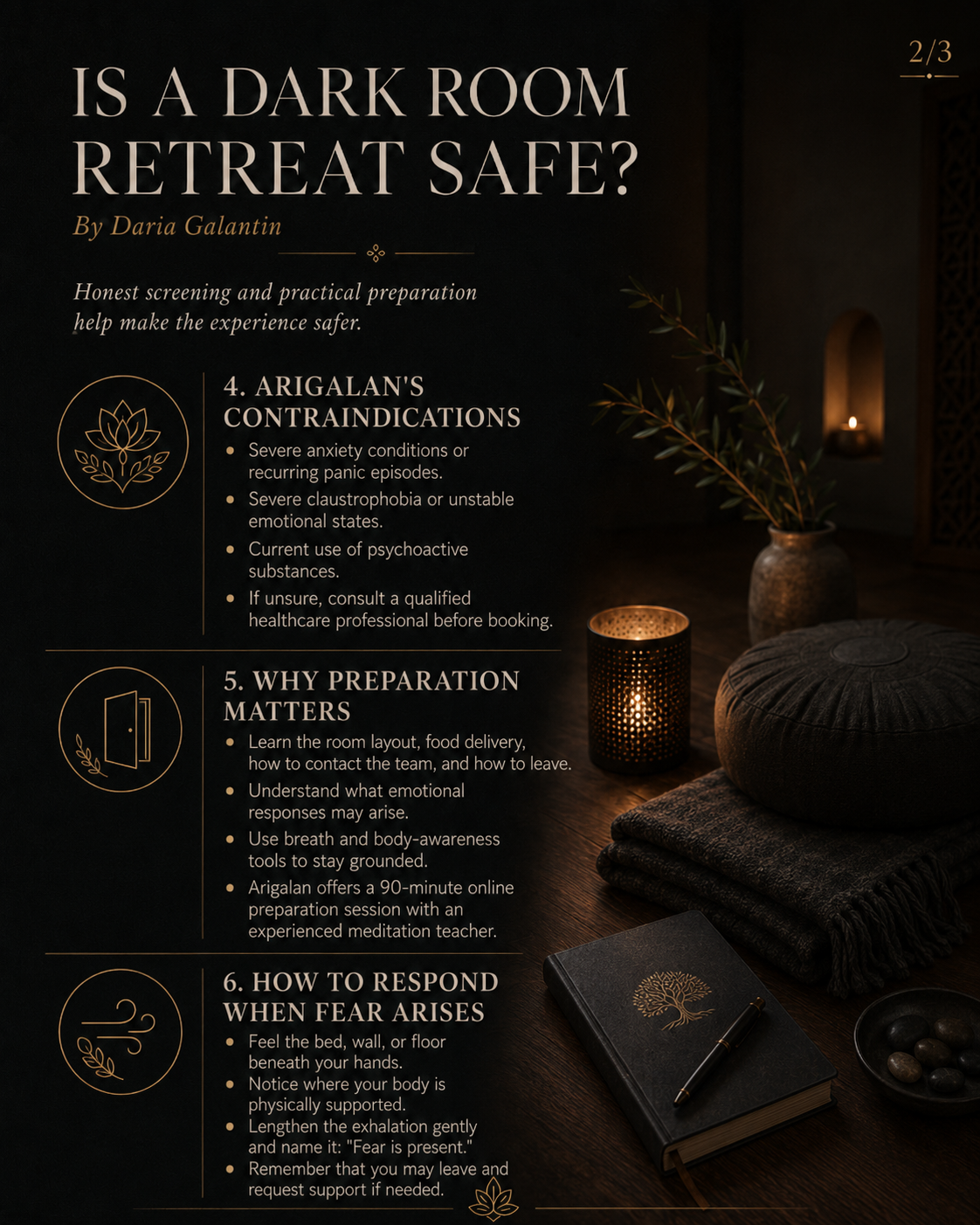
Arigalan’s current retreat guidance states that the dark room may not be suitable for people experiencing:
Severe anxiety conditions
Recurring panic episodes
Severe claustrophobia
Unstable emotional states
Current use of psychoactive substances
Participants are expected to communicate relevant health concerns honestly before booking.
A person with a significant psychiatric history, a medical condition requiring regular monitoring, or concerns about prolonged isolation should consult an appropriately qualified healthcare professional before participating.
A dark room retreat is not a replacement for psychotherapy, psychiatric care, medication, or medical treatment.
Why Preparation Matters
Fear often grows when the environment is unfamiliar and the participant does not know what to expect.
A preparation session can reduce uncertainty by explaining:
The physical layout of the room
How food is delivered
How to contact the team
How to leave
What emotional responses may arise
How to use breath and bodily awareness
How to distinguish challenge from overwhelm
Arigalan offers a 90-minute online preparation session with an experienced meditation teacher.
The teacher does not promise to prevent every difficult experience. The purpose is to help you enter informed, grounded, and equipped with practical tools.
How to Respond When Fear Arises
When fear appears, begin with simple actions:
Feel the bed, wall, or floor beneath your hands.
Notice where your body is physically supported.
Lengthen your exhalation without forcing the breath.
Name what is happening: “Fear is present.”
Remind yourself that you may leave.
Request support when the intensity feels unmanageable.
Trying to defeat fear can make it stronger. Grounding means returning to the immediate physical environment rather than arguing with the mind.
Is Sensory Reduction Scientifically Proven to Be Beneficial?
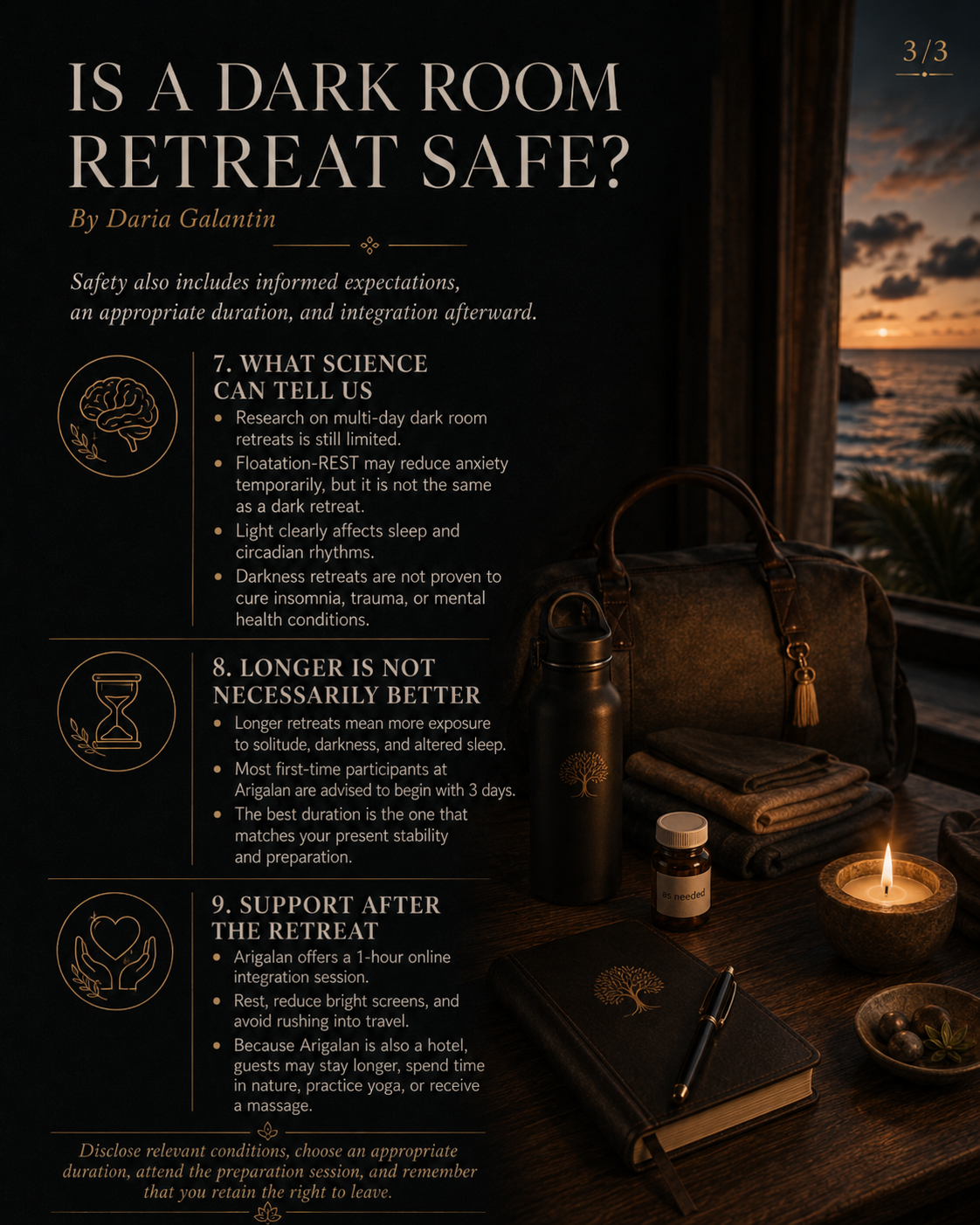
Direct scientific research on multi-day dark room retreats remains limited.
Studies of Floatation-REST—a shorter and very different form of voluntary reduced environmental stimulation—have reported temporary reductions in anxiety and muscle tension in some participants. These findings cannot be transferred directly to a multi-day darkness retreat.
Similarly, scientific research confirms that light influences sleep and circadian timing, but it does not prove that a darkness retreat will “reset” the nervous system, cure insomnia, heal trauma, or treat a mental health condition.
Longer Is Not Necessarily Safer or Better
Duration increases exposure to solitude, darkness, altered sleep, and reduced external orientation.
Most first-time participants at Arigalan are advised to begin with three days. Someone with substantial meditation and retreat experience may consider a longer duration, but experience alone does not remove all risk.
The right duration is the one that matches the participant’s present stability and preparation.
Support After the Retreat
Safety also includes the period after the door opens.
Arigalan offers a one-hour online integration session with an experienced meditation teacher. This provides space to discuss difficult emotions, unusual perceptions, insights, confusion, and the practical return to daily life.
Because Arigalan is also a hotel, guests may remain on the property after the retreat. They can rest, spend time in nature, practice yoga, receive a massage, or gradually reconnect with the nearby community instead of moving immediately into travel and stimulation.
Make an Informed Decision
A dark room retreat should be approached with curiosity and humility—not bravado.
Read the practical information, disclose relevant conditions, choose an appropriate duration, attend the preparation session, and remember that you retain the right to leave.
Read About Arigalan’s Dark Rooms
Frequently Asked Questions
Can a dark retreat cause hallucinations?
Some people report internally generated lights, patterns, sounds, or imagery. Such experiences vary and should not automatically be interpreted as spiritual or pathological.
Is it safe for someone with anxiety?
Mild anxiety does not automatically disqualify someone, but severe anxiety conditions or recurring panic episodes are listed among Arigalan’s contraindications. Discuss your situation before booking.
What happens when I request help?
The team can provide practical assistance and help you end the retreat when necessary.
Can I take medication inside?
Necessary medication should not be stopped. Discuss storage, timing, lighting requirements, and monitoring with the team beforehand.
Is leaving early a failure?
No. Leaving when the experience exceeds your capacity is a valid and responsible decision.